
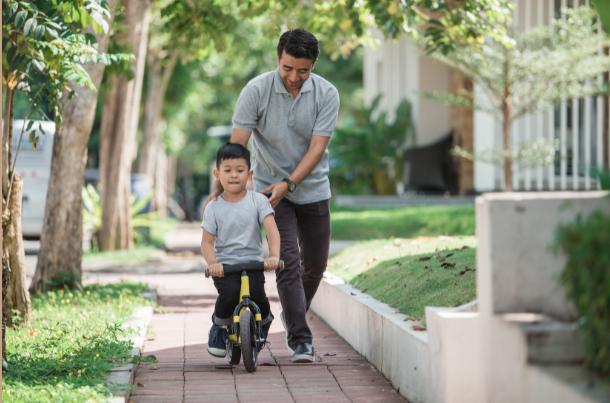
Knowing how to ride a bike safely for kids involves much more than learning to balance. Children also need a properly fitted helmet, a bike they can control, a safe place to practise, and simple rules they can remember when excitement takes over.
This guide will help you teach bike safety without making every ride feel frightening. The goal is not to remove all risk. It is to give your child the skills, habits, and supervision they need to enjoy cycling more safely and confidently.
Why Bike Safety Matters for Children
Cycling gives children opportunities to practise balance, coordination, bike control, and decision-making skills as they develop.
It is also a joyful way for families to be active together.
But a bicycle is more than a toy. A child must steer, brake, watch for hazards, judge speed, and sometimes respond to other people using the same path or road. Those tasks take practice, and a child who can pedal independently may not yet be ready to manage traffic.
A properly fitted helmet can reduce the risk of serious head injury, but a helmet is only one part of bike safety. Choosing a safer riding environment, keeping the bicycle in good condition, teaching predictable behaviour, and supervising according to the child’s abilities are equally important.
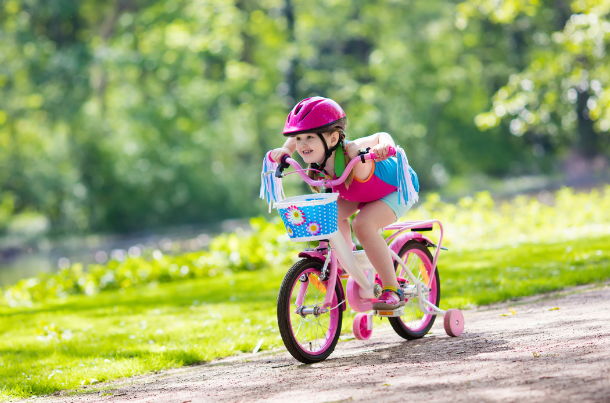
How to Ride a Bike Safely for Kids: 15 Essential Tips
Help your child enjoy every bike ride safely by teaching them simple habits like wearing a well-fitted helmet, checking their bike, staying alert, and following basic road rules.
1. Make a helmet non-negotiable
Your child should wear a bicycle helmet on every ride, even on a balance bike, tricycle, driveway, or short trip near home. Falls can happen at low speeds and in familiar places.
Choose a helmet made for bicycling and certified to the safety standard required in your country. In the United States, look for a label showing that the helmet meets the U.S. Consumer Product Safety Commission standard. A toy or costume helmet is not a substitute.
Adults should wear helmets too. “Everyone wears one” is much easier for a child to accept than a rule that seems to apply only to them.
2. Check that the helmet fits correctly
A helmet cannot do its job well if it slides around or sits on the back of the head.
Use this simple fit check:
- Level: The helmet should sit flat and low on the forehead, not tipped backward.
- Eyes: Your child should be able to look up and see the helmet’s front edge.
- Ears: The side straps should form a “V” just under and in front of each ear.
- Chin: The chin strap should be snug according to the helmet manufacturer’s instructions and should not hang loose.
- Movement: When your child shakes their head, the helmet should stay in place.
Adjust the sizing pads or rear dial according to the manufacturer’s instructions. Do not wear a thick hat under the helmet unless the helmet maker specifically allows it.
A helmet involved in a significant crash may need to be replaced even if damage is not obvious. Follow the manufacturer’s replacement guidance, and replace any helmet with cracks, crushed foam, broken straps, or a damaged buckle.
3. Choose a bike that fits the child now
A bicycle bought “to grow into” may be difficult to start, stop, and steer. Your child should be able to hold the handlebars comfortably, operate the brakes, and get on and off without struggling.
For beginner riders, being able to place the balls of both feet on the ground can help them feel more secure while learning. Bike fit varies by design, so follow manufacturer guidance or ask a bike shop if unsure.
Avoid choosing a bike by age alone. Height, inseam, coordination, hand strength, and experience all affect whether a child can control it safely.
4. Do a quick bike check before riding
Turn a short safety check into part of the family’s riding routine. Before setting off, check:
- Air: Tires feel properly inflated and are not badly worn or damaged.
- Brakes: Both brakes stop the bike and the levers are within easy reach.
- Chain and cranks: The chain is in place, and the pedals and cranks move normally.
- Quick releases: Wheel and seat fasteners are closed and secure.
- Handlebars and seat: Nothing is loose or twisted.
- Reflectors and lights: They are present, clean, secure, and working when needed.
If something looks loose, damaged, or unfamiliar, pause the ride until an adult who understands bike maintenance or a bicycle mechanic checks it.
5. Start in a quiet, traffic-free space
An empty paved area, quiet park path, or other legal traffic-free space gives a beginner room to practise without having to make complicated road decisions.
Children do not all learn these skills in exactly the same order, but useful skills to practise include:
- Looking ahead rather than down at the front wheel
- Starting smoothly
- Riding in a straight line
- Steering around wide obstacles
- Braking gradually and stopping under control
- Looking over one shoulder without swerving
Keep practice sessions short and encouraging. Tired or frustrated children make more mistakes, and confidence grows faster when the lesson ends on a positive note.
6. Teach children to stop before every driveway or crossing
Driveways, alleys, parking-lot exits, and intersections can be dangerous because a driver may not see a small child approaching.
Teach your child to stop completely, look carefully in all directions, listen for approaching vehicles, and move only when the crossing is clear.
Young children may not accurately judge how fast a vehicle is moving or how far away it is. They should cross busy streets with a responsible adult and, where local guidance recommends it, get off and walk the bike across.
7. Follow local road and sidewalk rules
Bicycle laws differ by country, state, and city. Some places allow young children to ride on sidewalks; others restrict sidewalk cycling in certain areas.
When riding on roads where cycling is permitted, children should follow local traffic laws, including required direction of travel, signals, signs, and lane markings.
Sidewalks are not automatically hazard-free. Children must watch for pedestrians, pets, driveways, doors, uneven surfaces, and vehicles entering or leaving properties. They should slow down, give an audible warning before passing, and yield as local rules require.
Check your local bicycle laws rather than assuming that rules are the same everywhere.
8. Choose a lower-risk route, not simply the shortest
For a child, a slightly longer route through a quiet neighbourhood or protected cycle path may be far safer than a direct route beside fast traffic.
Before allowing independent riding, travel the route together. Notice difficult intersections, blind driveways, construction, parked cars, steep slopes, loose gravel, and places where a bike lane disappears.
Until a child can consistently scan, signal, control the bike, and make safe decisions, ride alongside them or choose a traffic-free location. Readiness should be based on demonstrated skills, not only age.
9. Help your child stay visible
Drivers and other riders need time to notice a child. Bright or light-coloured clothing can improve visibility, while reflective details are helpful in low light.
Use a white front light and red rear light when required by law or when conditions make visibility poor. Reflectors support visibility, but they do not replace active lights when lights are needed.
Daylight is usually easier for children than dawn, dusk, darkness, rain, or fog. Beginners should avoid low-visibility conditions. Even in daylight, teach children not to assume that a driver has seen them.
10. Teach clear hand signals
Predictable riders are easier for others to understand. If looking behind causes your child to lose control, continue practising away from traffic before using these skills on roads.
teach the locally recognised signals for turning and stopping.
Practise signals in a traffic-free area first. A child should not remove a hand from the handlebar if doing so makes them wobble or lose control. In that case, they need more practice and adult supervision before riding near traffic.
Signals communicate an intention; they do not create a right of way. Children must still look carefully and move only when it is safe.
11. Keep hands, feet, and attention on the ride
Children should keep both hands on the handlebars except when they are giving a necessary hand signal.
on the handlebars. Items belong in a properly attached basket, pannier, or secure backpack, not dangling from a hand.
Tie shoelaces, tuck in loose pant legs, and avoid scarves or bag straps that could catch in the wheel or chain. Closed-toe shoes with secure soles are a practical choice.
Phones, headphones, toys, and snacks can take a child’s eyes, ears, or hands away from riding. Teach them to stop in a safe place before adjusting clothing, checking a device, drinking, or handling an item.
12. Ride predictably and leave enough space
When riding as a family, avoid crowding. Leave enough distance for each rider to stop if the person ahead slows suddenly.
Children should not race unexpectedly, weave around others, grab another bike, or carry passengers on a bicycle that is not designed for them. They should slow down around pedestrians and use a bell or friendly voice before passing without startling anyone.
On shared paths, model calm, courteous riding. Safety rules are easier to remember when children see adults following them consistently.
13. Adjust supervision to the child’s ability
There is no single age when every child is ready to ride alone. Consider whether your child can:
- Start and stop without losing control
- Brake firmly without panicking
- Ride a straight line while looking around
- Recognise common road signs and hazards
- Follow rules even when friends are present
- Make safe choices without repeated reminders
- Handle the specific route and traffic conditions
A child may be physically skilled yet still too impulsive or easily distracted for independent street riding. Increase freedom gradually: first a contained area, then a quiet path with an adult, then carefully selected routes as skills and judgement develop.
14. Know what to do after a fall
After a crash, move away from traffic if it is safe to do so. Check the child before checking the bike.
Call emergency services for loss of consciousness, seizure, difficulty breathing, severe bleeding, neck pain, weakness, confusion, repeated vomiting, worsening headache, unusual sleepiness, or a child who is difficult to wake. A significant impact can cause a concussion even when there is no visible cut or bump.
After a head impact, monitor your child closely. Seek medical advice if symptoms develop or if the impact was significant. Seek urgent care for the warning signs listed above.
Inspect the helmet and bicycle before the next ride. Damage to the brakes, wheels, frame, fork, handlebars, or helmet may not be safe to ignore.
15. Keep the lesson simple and positive
A long list of warnings can make a child tune out or become anxious. Choose a few short phrases and repeat them before every ride:
Helmet on. Bike checked. Eyes up. Stop and look. Ride predictably.
Praise safe choices rather than speed. “I noticed you stopped at that driveway”Specific praise helps children understand which safe behaviour they should repeat.
because it tells the child exactly what they did well.
A Simple Pre-Ride Safety Checklist for Kids
Before every ride, ask your child:
- Is my helmet level and buckled snugly?
- Are my tires firm and my brakes working?
- Are my shoelaces tied and loose clothing tucked away?
- Can other people see me?
- Do I know where I am allowed to ride?
- Am I ready to stop, look, and listen at crossings?
- Is an adult coming with me if the route requires supervision?
Posting this checklist near the bikes can help safe habits become automatic.
Common Bike Safety Mistakes Parents Can Avoid
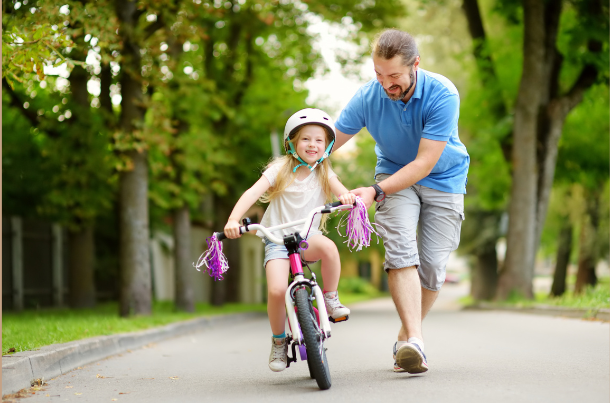
Even careful parents can overlook simple bike-safety details, such as using the wrong bike size, fitting the helmet incorrectly, or letting a child ride without enough supervision. Understanding these common mistakes can help make every ride safer and more enjoyable.
Parenting involves learning as your child grows, so occasional oversights are completely normal. If you have ever worried about getting everything right, this guide to common mistakes new parents make and how to avoid them offers practical, reassuring advice.
Buying a bike that is too large
A bigger bike may seem economical, but it can make starting, stopping, and emergency manoeuvres harder. A bike that fits today is the safer choice.
Letting the helmet tilt backward
A helmet worn like a bonnet leaves the forehead exposed. Recheck the position and straps whenever your child puts it on.
Assuming a skilled rider is traffic-ready
Balance and pedalling are physical skills. Traffic riding also requires attention, judgement, impulse control, and an understanding of road rules.
Treating a quiet street as an empty street
Cars can appear suddenly from driveways, corners, or parking spaces. Continue teaching scanning and stopping habits even where traffic is usually light.
Allowing distractions
Music, messages, and conversation can reduce awareness. Children need their eyes and ears available to notice vehicles, pedestrians, animals, and changes in the surface.
Frequently Asked Questions
What is the most important bike safety rule for kids?
Should children ride bikes on the sidewalk or road?
How should a child’s bicycle helmet fit?
Can my child use a second-hand helmet?
When is a child ready to ride without an adult?
Should children wear helmets on balance bikes and tricycles?
Should I replace my child’s helmet after a crash?
A Gentle Reminder for Parents
Teaching a child to ride safely does not happen in one perfect afternoon. They may forget to look over their shoulder, brake too suddenly, or become distracted by a friend. That does not mean the lesson is failing.
Keep practising in small steps. Repeat the same simple rules. Model the behaviour you want to see, including wearing your own helmet and stopping fully at crossings.
As your child’s balance improves, let their judgement grow alongside it. The real milestone is not simply riding without help. It is learning to make calm, predictable choices while enjoying the wonderful freedom a bicycle can bring.
For more practical tips to support your child’s safety, development, and everyday adventures, visit Little One Haven and explore helpful parenting guidance created with growing families in mind.
This article focuses on regular pedal bicycles. E-bikes involve additional speed, equipment, age, and legal considerations, so check local rules and safety guidance before allowing children to use one.
Trusted Resources
- Bicycle Safety, Centers for Disease Control and Prevention
- Bicycle Safety, National Highway Traffic Safety Administration
- Fitting Your Bike Helmet, NHTSA
- Recreational Helmets and Bicycle Helmet Standards, U.S. Consumer Product Safety Commission
- American Academy of Pediatrics / HealthyChildren — Your Child’s First Tricycle or Bike: Teaching Them to Ride Safely
Disclaimer
This article is intended for general educational and parenting information only and does not replace professional safety, medical, legal, or cycling instruction. Bicycle laws, helmet requirements, sidewalk rules, and road regulations vary by location, so always follow your local laws and official safety guidance. Children should be supervised according to their individual riding skills, judgement, and the environment. After a bicycle crash, seek urgent medical care if your child has loss of consciousness, a seizure, difficulty breathing, severe bleeding, neck pain, weakness, confusion, repeated vomiting, worsening headache, unusual sleepiness, or is difficult to wake.
About the Author
Geeta Yogi writes practical, parent-friendly content about child safety, development, outdoor activities, healthy routines, and everyday parenting. She focuses on helping families build simple, realistic safety habits that support children as they gain confidence and independence.
