

Welcoming a newborn into your life is a truly special and unforgettable journey. While it brings immense joy and excitement, it can also feel overwhelming, especially for first-time parents. It’s completely natural to experience a mix of emotions, from happiness to a bit of nervousness.
If you’re wondering how to manage essential newborn care in those early days, you’re not alone. Every parent learns step by step, and with the right guidance, it becomes easier and more natural.
Let’s walk through simple and practical tips to help you feel confident in caring for your little one.
Understanding essential newborn care helps parents feel more confident and prepared during the early days.
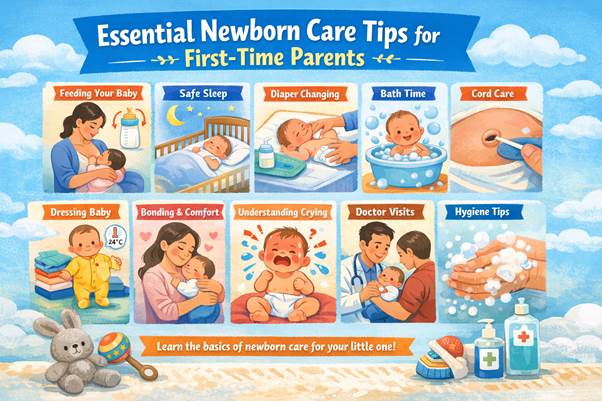
Essential Newborn Care Tips for First-Time Parents
This guide covers the 10 steps of essential newborn care, along with a few extra tips to help you feel more prepared and relaxed.
1. Feeding Your Newborn (How to feed your baby)
Feeding is the most important thing for a newborn baby. In the early days, a baby usually feeds every 2–3 hours. If you are breastfeeding, it’s best to feed your baby on demand. When the baby moves their lips, puts their hands in their mouth, or seems restless, these are signs of hunger.
If you are breastfeeding, try to feed on demand. Small cues like lip movement, sucking hands, or restlessness often mean your baby is hungry.
For formula feeding, always ensure bottles are clean and the quantity is correct. Don’t forget to burp your baby after feeding to prevent discomfort.
2. Baby Sleeping Routine (Your baby’s sleep routine)
A newborn baby sleeps most of the time, about 14–17 hours a day. However, they do not sleep for long stretches at once.
It is safest to always put the baby to sleep on their back. Avoid placing soft pillows, toys, or heavy blankets on the bed. Gradually, the baby’s sleep pattern will develop, so there’s no need to worry in the beginning.
Understanding sleep is an important part of how to care for a newborn baby.
3. Diapering & Hygiene (Cleanliness and diaper care)
A baby’s skin is very sensitive, so it’s important to change diapers on time. Check the diaper every 2–3 hours.
While changing, clean the baby gently and let the skin dry. To prevent diaper rash, you can use a rash cream and also give some diaper-free time during the day.
4. Bathing Your Newborn (Bathing your baby)
In the beginning, give a sponge bath instead of a full bath until the umbilical cord heals.
Always use lukewarm water and support the baby properly. Use a mild baby soap. Bath time can also be a great bonding moment.
5. Umbilical Cord Care (Navel care)
The baby’s umbilical stump falls off on its own in a few days.
Keep it clean and dry. Fold the diaper below this area so air can pass. Never pull it forcefully. If you notice redness or a bad smell, consult a doctor.
6. Baby Clothing & Temperature (Clothing and temperature care)
Newborns cannot regulate their body temperature well, so dressing them comfortably is important.
Soft cotton clothes are best. Generally, dress the baby in one more layer than yourself. Avoid overdressing, as it can cause overheating.
7. Bonding with Your Baby (Building a connection)
Bonding is a beautiful part of essential newborn care.
Skin-to-skin contact, talking, eye contact, and cuddling help your baby feel safe and loved while supporting emotional development.
8. Understanding Baby’s Cry (Understanding why your baby cries)
A newborn cannot speak, so crying is their way of communicating.
Each cry may have a different reason, hunger, a dirty diaper, sleepiness, or discomfort. Over time, parents learn to understand their baby’s patterns.
9. Health & Doctor Visits (Health check-ups)
Regular doctor visits and vaccinations are very important for your baby.
Tracking the baby’s weight, feeding, and growth is essential. If the baby has a fever, is not feeding, or is crying excessively, consult a doctor immediately.
10. Hygiene for Parents & Visitors (Maintaining cleanliness)
A newborn’s immune system is weak, so hygiene is very important.
Always wash hands before touching the baby. Avoid too many visitors, especially in the first few weeks.
11. Self-Care for Parents (Taking care of parents)
New parents often ignore their own health, which is not good.
Rest when the baby sleeps, eat healthy food, and share responsibilities. Don’t hesitate to ask for help.
12. Common Mistakes to Avoid (Mistakes to avoid)
Parenting a newborn comes with a lot of love… but also a lot of learning. It’s completely normal to make mistakes, especially as a first-time parent. The key is to stay aware, trust yourself, and grow along the way
Here are some common mistakes many parents make, and how you can gently avoid them:
Overdressing the baby
It’s natural to worry if your baby is feeling cold, but overdressing can actually make them uncomfortable or even cause overheating. A simple rule is to dress your baby in one extra layer than what you’re comfortable wearing.
Ignoring the baby’s signals
Babies communicate through small cues, crying, facial expressions, body movements. Sometimes we miss these signals or misunderstand them. With time, you’ll start recognizing what your baby needs, whether it’s hunger, sleep, or comfort.
Taking too much stress
Trying to do everything “perfectly” can become overwhelming. Remember, there is no perfect way to parent. Your baby doesn’t need perfection, they need your love, patience, and presence.
Comparing with other babies
This is one of the most common and stressful mistakes. Every baby grows and develops at their own pace. Some walk early, some talk later, and both are completely normal. Comparing only creates unnecessary worry.
At the end of the day, parenting is not about getting everything right… it’s about learning, adapting, and loving your baby unconditionally. Trust your instincts, you’re doing better than you think
13. Building a Simple Routine (Creating a routine)
In the early days, your newborn won’t follow a strict routine, and that’s completely normal. Babies are still adjusting to the world outside the womb, so everything feels new to them. Instead of a fixed schedule, you’ll start noticing a gentle pattern forming over time.
A simple and natural cycle often looks like this:
Feed → Sleep → Wake → Play a little → Repeat
At first, this pattern may feel unpredictable. Some days your baby may sleep longer, while on other days they may want to feed more often. Gradually, you’ll begin to recognize your baby’s rhythm, when they feel hungry, when they’re sleepy, and when they’re calm and ready to interact.
That “play time” doesn’t have to be anything complicated. It can be as simple as making eye contact, talking softly, cuddling, or letting your baby observe their surroundings. These small moments are very meaningful for their development.
Consistency, even in small ways, makes a big difference. When you respond to your baby’s needs in a similar pattern each day, it creates a sense of comfort and security, not just for your baby, but for you as well.
14. Emotional Support & Confidence (Confidence and support)
New parents may sometimes feel fear and confusion, which is completely normal.
Trust yourself. You may not be perfect, but your love matters the most. Support from family and friends can be very helpful.
Final Thoughts
Taking care of a newborn may feel challenging at first, but it becomes easier with time and experience. Following these 10 steps of essential newborn care can help you feel more confident and prepared.
The most important thing is to trust your instincts. Your love, care, and patience are the greatest support for your baby.
You don’t need to be a perfect parent, being a present and caring parent is enough.
Enjoy every little moment, because this beautiful phase passes faster than you think.
For more helpful tips and guidance on your parenting journey, visit: littleonehaven
FAQs (Frequently Asked Questions)
1. How often should a newborn be fed?
A newborn should be fed every 2–3 hours or whenever they show signs of hunger.
2. How much does a baby sleep during the day?
A newborn sleeps about 14–17 hours, but in short intervals.
3. How often should diapers be changed?
Every 2–3 hours or immediately when the diaper becomes wet or dirty.
4. What are the main reasons a baby cries?
Hunger, sleepiness, a dirty diaper, or discomfort are the most common reasons.
5. Is it necessary to bathe a newborn daily?
No, daily bathing is not necessary. Bathing every 2–3 days and sponge cleaning on other days is enough.
6. What is the safest way to put a baby to sleep?
Always place the baby on their back and avoid soft items on the bed.
7. Is it normal for first-time parents to feel stressed?
Yes, it’s completely normal. Every parent feels nervous in the beginning, but confidence builds over time.
8. What are the most important newborn care tips?
Feeding on time, proper sleep positioning, hygiene, and regular doctor check-ups are some of the most important newborn care tips.