

If you often find yourself wondering, “Why is my 7-year-old so hard on himself?”, you are not alone. Maybe he becomes tearful after getting one spelling word wrong, crumples a drawing that looks perfectly lovely to you, or says, “I’m terrible at this,” when something does not work on the first try.
Hearing your child speak about himself this way can be heartbreaking. You may want to immediately tell him that he is clever, capable, and wonderful. While that reassurance comes from love, a child who is caught in a wave of disappointment may not be ready to believe it.
At seven, children are becoming more aware of rules, results, and how they compare with others. Some are naturally more sensitive or determined to do things well. Being hard on himself does not mean your child is unhappy or that you have done something wrong. It may simply mean that he needs help learning a skill that takes time for all of us: how to make mistakes without turning them into a judgment about who we are.

Why Is My 7-Year-Old So Hard on Himself?
There is rarely one simple reason. A child’s temperament, school experiences, friendships, expectations, and current stress can all influence the way he responds to mistakes.
Seven-year-olds are also in an interesting stage of development. They can notice that one child reads faster, another runs farther, and someone else always seems to know the answer. However, they may not yet understand that people learn at different speeds or that effort is often invisible. They see the finished result, not all the practice behind it.
Your child may also think in all-or-nothing terms. In his mind, a picture is either “good” or “bad.” He either knows the answer or feels “stupid.” One small error can seem much bigger to him than it does to an adult.
This harsh reaction is not usually attention-seeking. The disappointment often feels very real in that moment.
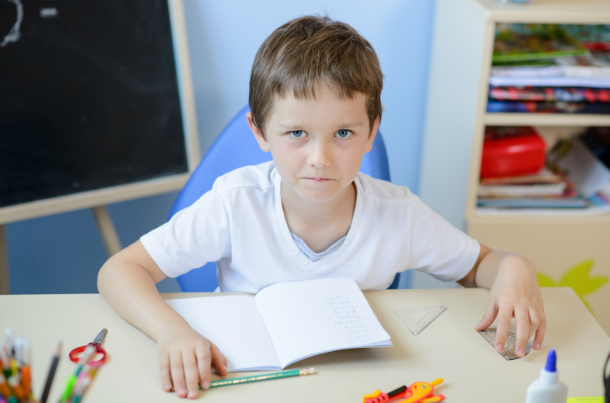
Common Reasons a 7-Year-Old Becomes Self-Critical
He has a naturally sensitive temperament
Some children feel everything deeply. A small correction that another child brushes off may stay in a sensitive child’s mind for hours. He may notice changes in your voice, worry about disappointing people, or replay an uncomfortable moment from school.
Sensitivity is not a flaw. These children are often thoughtful, caring, and wonderfully observant. They simply need extra help separating feedback about something they did from a judgment about who they are.
He wants to please the adults around him
A child who loves praise may begin to believe that doing well is how he earns approval. Even in a warm home, he can quietly put pressure on himself to be the “good,” “smart,” or “helpful” child.
This does not necessarily mean anyone has demanded perfection. Children sometimes create their own expectations from everyday comments, classroom rewards, or the attention given to achievement.
He is comparing himself with other children
School makes differences in ability easier to see. Your child may notice who finishes first, who receives a sticker, or who gets invited to join a game. At seven, he may compare his hardest moment with someone else’s strongest one.
Competition can motivate some children, but for a self-critical child, it can make ordinary learning feel like proof that he is falling behind.
Something feels genuinely difficult
Sometimes negative self-talk appears because a child is working harder than everyone realizes. Reading, handwriting, attention, coordination, or understanding instructions may feel exhausting. When a child cannot explain the difficulty, “I’m bad at everything” may be the only language he has for it.
Notice when the frustration happens. Is it mostly during homework? Before school? While playing sports? A pattern can help you understand what support he needs.
He is copying the language he hears
Children listen closely to the way adults speak about themselves. If they regularly hear “I’m so stupid,” “I look awful,” or “I can never get anything right,” they may learn that harsh self-criticism is a normal response to frustration.
There is no need to blame yourself if you recognize this. It is simply an opportunity to model a kinder response out loud: “I made a mistake, so I’m going to slow down and try again.”
He is tired, hungry, or overwhelmed
A difficult reaction is not always a deep emotional problem. Children have less patience and flexibility when they are tired, hungry, overstimulated, or carrying stress from a busy day.
If homework regularly ends in tears, consider whether your child needs food, movement, connection, or rest before he needs another worksheet. A shorter, calmer routine can sometimes make a surprising difference.
If homework itself is becoming a regular source of stress, this guide to creating a daily study routine for kids offers practical ways to use shorter study sessions, breaks, and realistic expectations without making learning feel like a daily battle.
What Self-Criticism Can Look Like at Age Seven
Not every self-critical child says, “I am hard on myself.” You may instead notice that your child:
- gives up quickly if he cannot do something immediately
- erases repeatedly or starts work over several times
- avoids activities in which he may not be the best
- becomes very upset by gentle correction
- calls himself “stupid,” “bad,” or “a failure”
- struggles to accept compliments
- worries excessively about disappointing a teacher or parent
- compares his work, body, or abilities with other children
- has a meltdown after a seemingly small mistake
An occasional frustrated comment is common. Pay closer attention when the pattern is frequent, intense, or begins to affect school, friendships, sleep, family life, or your child’s willingness to try.
How to Respond in the Moment
When your child says, “I’m the worst at this,” your first instinct may be to reply, “No, you’re not!” The problem is that immediate contradiction can turn the conversation into an argument. Your child feels awful, while you are trying to prove that he should not.
Start by connecting with the feeling.
You might say:
- “You really wanted to get that right.”
- “That mistake felt upsetting.”
- “I can see how frustrated you are.”
- “You worked hard, and the result was not what you hoped for.”
Once he feels understood, gently separate the mistake from his identity: “Getting one answer wrong does not mean you are bad at maths. It means this part is still tricky.”
Keep your voice calm and your words short. A seven-year-old in distress usually cannot absorb a long lesson. Help him settle first; talk about what happened later.
How to Help a 7-Year-Old Stop Being So Hard on Himself
Praise the process, but keep it specific
Instead of giving general praise such as “You’re so smart,” notice something your child can understand and repeat.
Try saying, “You kept going even when that sentence was difficult,” or “I noticed you checked your work carefully.” This teaches him that success is not a fixed label. It grows through patience, strategy, practice, and asking for help.
Do not feel you must praise every action. Warm attention and honest encouragement feel more meaningful than constant applause.
Make mistakes ordinary at home
Let your child see you make small mistakes without becoming ashamed. If you burn the toast, miss a turn, or forget an item at the shop, narrate a healthy response.
“Oops, I forgot the milk. That is inconvenient, but I can add it to tomorrow’s list.”
This shows your child that mistakes can be handled. They do not have to become emergencies or evidence that someone is not good enough.
Replace perfection with “good enough”
Perfectionism can make even simple tasks exhausting. Help your child recognize when a job has met its purpose.
You might ask, “Does your teacher need perfect handwriting, or writing that is neat enough to read?” For a drawing, you could say, “Art does not have to look exactly like the picture in your head to be worth enjoying.”
The goal is not to lower every expectation. It is to teach flexibility.
Give him language for the inner critic
Some families find it helpful to give harsh thoughts a playful name, such as the “bossy voice” or “perfection monster.” This helps a child see that a thought is something he is experiencing, not an unquestionable fact.
When he says, “I can’t do anything,” you can ask, “Is that your helpful voice talking, or is the perfection monster getting loud?” Then work together on a fairer sentence: “I cannot do this yet, but I can learn one step at a time.”
Avoid rushing in to fix everything
It is painful to watch your child struggle, but solving every problem for him can accidentally suggest that he cannot cope. Stay close and offer just enough support.
Ask, “Would you like a hint, a short break, or for me to sit beside you while you try?” Giving a few choices restores a sense of control without removing the challenge completely.
Protect time for play and rest
Children need spaces where there are no grades, scores, or polished results. Outdoor play, building, pretend games, music, and silly family time give your child room to experiment without being evaluated.
Focus on progress over comparison
Try not to compare your child with siblings, classmates, or even yourself at the same age. Instead, compare his current progress with where he started.
“Last month you needed help with every line. Today you read most of the page by yourself.”
That kind of observation helps him see growth that might otherwise be hidden by his desire to do everything perfectly.
Create a simple reset routine
When mistakes lead to tears or anger, agree on a short routine during a calm moment. It could be:
- Stop and put the pencil down.
- Take three slow breaths.
- Say, “This is hard, but I am safe.”
- Choose a break, some help, or one more attempt.
Practise the routine when your child is relaxed. It is much easier to use a skill during frustration when it already feels familiar.
Phrases That Build a Kinder Inner Voice
The language your child hears repeatedly can slowly become the language he uses with himself. Helpful phrases include:
- “You can be disappointed without being mean to yourself.”
- “One mistake tells us what to practise next.”
- “Hard does not mean impossible.”
- “You do not have to be the best to enjoy something.”
- “Your work can need improvement, and you can still be proud of your effort.”
- “Would you say that to a friend? What could you say to yourself instead?”
- “You are loved on successful days and difficult days.”
These phrases will not transform negative self-talk overnight. Their power comes from gentle repetition and from seeing adults live by the same message.
What Parents May Want to Avoid
Try not to dismiss the feeling with “That’s silly,” “It’s not a big deal,” or “Stop being dramatic.” The problem may look small to you, but the emotion is large for your child.
It also helps to avoid excessive reassurance. Repeatedly promising, “You are the best in the class,” may make your child more dependent on outside confirmation. A steadier response is: “You do not have to be the best. You are learning, and we can handle mistakes together.”
Finally, avoid labelling him as “the perfectionist” in front of others. A behaviour can change; a label can begin to feel like an identity.
When Should You Seek Extra Support?
Many children become kinder to themselves with patience, emotional coaching, and less pressure. Still, it is wise to seek support if your child’s self-criticism is persistent or affecting daily life.
Speak with his teacher and healthcare professional if he:
- regularly refuses school or activities because he fears mistakes
- has frequent stomach aches, headaches, sleep problems, or intense worry
- loses interest in things he once enjoyed
- repeatedly says he is worthless, unwanted, or a failure
- has strong emotional outbursts that are becoming more frequent
- seems to struggle with learning, attention, or friendships
- talks about hurting himself or not wanting to be alive
Comments about self-harm or not wanting to live should always be taken seriously. Stay with your child and seek urgent professional or emergency help in your country.
Asking for support does not mean you have failed. A teacher, pediatrician, school counselor, or child therapist can help identify whether anxiety, learning difficulties, bullying, or another concern is adding to the pressure your child feels.
Frequently Asked Questions
Is it normal for a 7-year-old to be hard on himself?
Occasional frustration and self-critical comments can happen, especially when children are learning difficult skills or comparing themselves with others. Pay closer attention when the pattern is frequent, intense, or affects school, sleep, friendships, or willingness to try.
What should I say when my child says “I’m stupid”?
Start by acknowledging the frustration rather than immediately arguing. You might say, “That felt really difficult.” Then gently separate the mistake from your child’s identity: “Getting something wrong doesn’t mean you’re stupid. It means this part is still hard.”
How can I help my 7-year-old with perfectionism?
Model calm responses to mistakes, praise specific effort and strategies, reduce unnecessary comparisons, and help your child recognize when work is “good enough” rather than perfect.
Should I correct negative self-talk every time?
You do not need to turn every comment into a long lesson. Acknowledge the feeling, offer a fairer way of describing the situation, and model kinder self-talk consistently over time.
When should I worry about my child’s negative self-talk?
Seek professional guidance when negative self-talk is persistent, severe, or accompanied by school avoidance, intense anxiety, sleep problems, loss of interest, significant learning difficulties, or statements about worthlessness or self-harm.
Final Thoughts
If you have been asking, “Why is my 7-year-old so hard on himself?” remember that self-criticism often grows from caring deeply, wanting to do well, and not yet knowing how to cope with disappointment.
Your child does not need you to erase every difficult feeling or convince him that everything he does is perfect. He needs a steady adult who can show him that mistakes are survivable, effort matters, and love does not disappear when things go wrong.
Change may be gradual. One day he may still crumple the page; another day he may pause, breathe, and try again. That small pause is progress.
Keep offering the message he will eventually learn to give himself: “You are more than this moment. You are still learning, and you do not have to be perfect to be loved.”
For more practical guidance on school-age development, confidence, learning, and everyday parenting challenges, explore more helpful parenting resources from littleonehaven.
Trusted Resources
- American Academy of Pediatrics / HealthyChildren
- CDC — children’s mental health
- NIMH — child/adolescent mental health and warning signs
Note: This article provides general parenting information and is not a substitute for individualized advice from your child’s pediatrician, teacher, school counselor, or mental health professional.