Most babies say their first meaningful word around their first birthday, although every baby develops at their own pace. Some little ones begin using recognizable words earlier, while others spend more time listening, observing, pointing, and babbling before their words arrive.
As a mom, I know how easy it is to compare your baby with another child who seems to be talking already. But language development is not a race. There are many little steps that happen before that first precious word, and every one of them matters.
When Do Infants Say Their First Word?
Most babies say their first recognizable word at around 12 months old.
The American Academy of Pediatrics notes that most children speak their first word around their first birthday, although there is plenty of normal variation from one child to another.
Some babies may say a meaningful “mama,” “dada,” “bye,” or another simple word before 12 months. Others may take a little longer.
By about 15 months, the CDC lists trying to say one or two words besides “mama” or “dada” as a common language milestone.
So if your baby’s first birthday arrives without a perfectly clear word, please do not immediately assume something is wrong.
There is much more happening with language than the number of words your baby can say.
What Actually Counts as a Baby’s First Word?
This question can cause a lot of debate in families.
Grandma may insist your six-month-old clearly said “mama.” Dad might be convinced the baby said “ball.” Meanwhile, your baby may simply be happily experimenting with sounds.
For a sound to count as a true first word, your baby generally needs to use it consistently and with meaning.
For example, if your baby says “mama” while looking at you or calling for you, that may count as a meaningful word.
If they randomly say “mamamamama” while playing with their toes, it is probably still babbling.
Your baby’s first word does not need to sound perfect, either.
A baby might say “ba” every time they see a ball or “da” whenever they see the family dog.
According to the American Academy of Pediatrics, a baby’s word can be any consistent sound that refers to the same person, object, or event.
So do not worry if your baby’s version of “banana” sounds nothing like the word you use.
The meaning behind the sound is what makes it special.
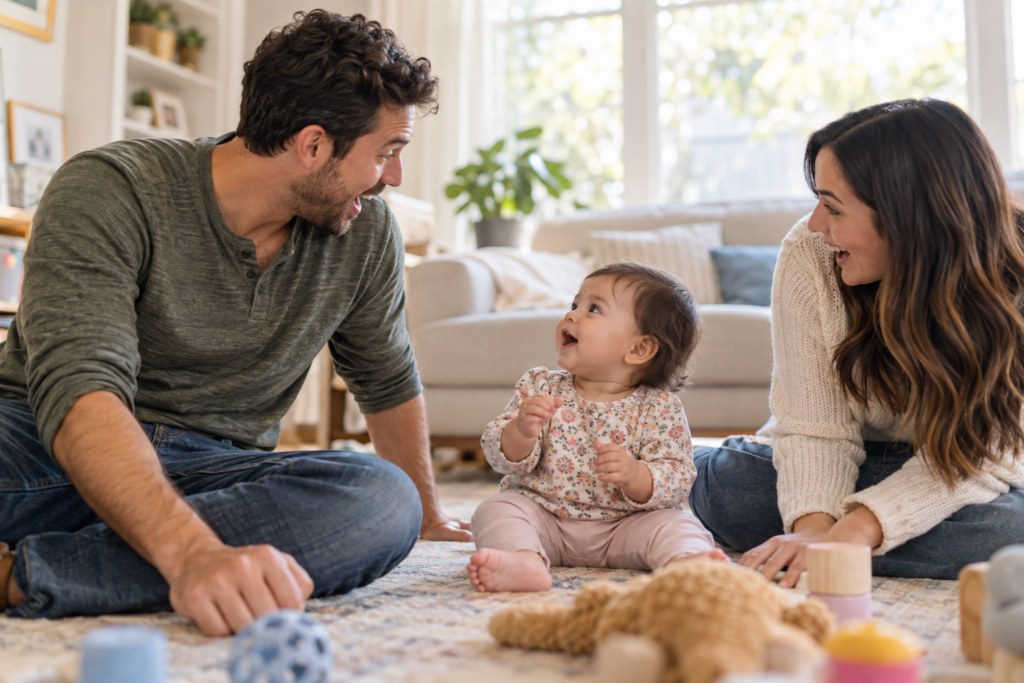
When Do Babies Start Talking Before Their First Word?
Talking does not suddenly begin the day your baby says “mama.”
Language development has actually been happening from the very beginning. Even crying is an early form of communication, and learning why babies cry and what they may be trying to tell you can make those first months feel a little less confusing.
Long before babies speak, they are listening to your voice, watching your face, noticing patterns in conversation, and discovering that sounds can get a response.
That adorable first word is really the result of months of tiny communication milestones.
Birth to Around 3 Months: Listening and Cooing
During the newborn months, your baby is already learning about communication.
They hear your voice while you feed them.
They listen while you whisper during those middle-of-the-night diaper changes.
They begin recognizing the voices of the people who care for them most.
Around the first few months, many babies start making little cooing sounds such as “ooo” and “ahh.”
When you smile, talk back, and respond, your baby begins learning one of the most important lessons about communication:
When I make a sound, someone responds.
That simple back-and-forth is the beginning of conversation.
Around 4 to 7 Months: Babbling Begins
This is often when things start getting very entertaining.
You may suddenly hear:
“Ba-ba-ba.”
“Da-da-da.”
“Ga-ga-ga.”
At first, these sounds do not necessarily have meaning.
Your baby is practicing how their tongue, lips, and mouth work together to create different sounds.
The American Academy of Pediatrics notes that repetitive sounds such as “bah” and “dah” commonly begin during this stage.
You may also notice your baby experimenting with volume.
Sometimes they whisper.
Sometimes they squeal.
Sometimes they discover they can shriek loudly enough to make everyone in the grocery store turn around.
It is all part of learning how their voice works.
Around 8 to 12 Months: Communication Becomes More Intentional
During these months, babbling often begins sounding increasingly like real speech.
You may notice pauses, changes in tone, and little strings of sounds that almost sound like your baby is telling you an extremely important story.
Babies may also begin communicating with gestures.
They might:
- Reach for something they want
- Point toward an interesting object
- Wave goodbye
- Raise their arms to be picked up
- Shake their head
- Look toward something when you name it
These gestures matter.
Your baby is learning that they can communicate an idea to another person even before they have the words to say it.
The American Academy of Pediatrics describes pointing, gestures, babbling, and imitation as important parts of language development during the later months of the first year.
Baby First Words Age: Is 12 Months a Strict Deadline?
No. Twelve months is a helpful average, not a strict deadline.
Baby development rarely follows an exact calendar.
One child may walk at ten months and say very little.
Another may happily talk from the floor while showing absolutely no interest in walking.
And both may be developing normally.
The same applies to speech.
Some babies have a couple of recognizable words by their first birthday.
Others are still mostly babbling but clearly understand what their parents are saying.
What matters is the overall pattern of communication development rather than one single milestone on one particular day.
Common First Words Babies Say
Parents often imagine their baby’s first word will be “mama.”
And sometimes it is.
But babies have their own plans.
Common early words may include:
- Mama
- Dada
- Hi
- Bye
- Ball
- Dog
- Cat
- No
- More
- Milk
- Baby
- Up
Sometimes the first word is surprisingly specific.
A baby who adores the family dog may attempt the dog’s name before saying anything else.
Another might become obsessed with ceiling fans and create their own special word for “fan.”
There is no correct first word.
The important part is that your baby connects a sound with a meaning.
Signs Your Baby Is Getting Ready to Talk
One of the sweetest parts of infant language development is watching all the little clues that appear before actual words.
Your baby may be getting closer to talking if they are beginning to imitate sounds you make.
They might watch your mouth carefully when you speak.
They may babble with different tones, almost as though they are practicing conversation.
They might also understand more words than they can actually say.
For example, you may ask:
“Where’s your cup?”
And your baby immediately looks toward it.
That is a wonderful sign of language understanding.
Remember that understanding language often develops faster than speaking it.
Babies can often understand familiar words and phrases before they are able to say them clearly themselves.
How to Encourage Baby to Talk Naturally
You do not need expensive toys, flashcards, apps, or complicated language programs to help your baby learn to talk.
Some of the best language learning happens during ordinary family life.
Talk Through Your Day
Narrate little moments naturally.
You might say:
“Let’s put your socks on.”
“Here’s your bottle.”
“Look at that big yellow bus.”
“We’re washing your hands.”
It may feel silly talking to someone who cannot answer you yet, but your baby is absorbing far more than you realize.
They are hearing vocabulary, rhythm, pronunciation, and sentence patterns.
Respond to Their Babbling
When your baby says:
“Ba-ba-ba!”
You can respond:
“Ba-ba! You have lots to say today!”
Then pause.
Sometimes your baby will answer with another burst of babbling.
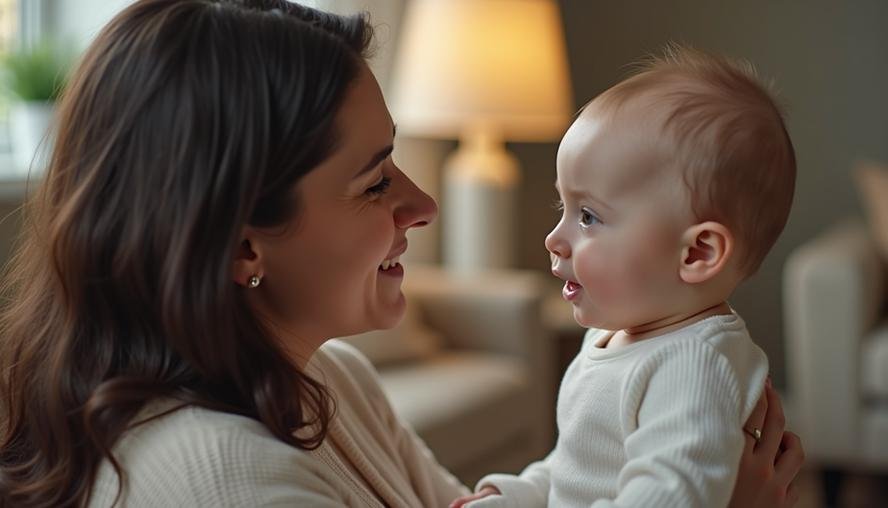
That simple exchange teaches an important communication skill called turn-taking.
They are learning:
You talk. I listen. I talk. You listen.
That is the foundation of conversation.
Follow What Your Baby Is Interested In
You do not always need to decide what to teach.
Follow your baby’s attention.
If they are staring at a bird outside, say:
“Bird! Look at the bird.”
If they are holding a spoon, say:
“Spoon. That’s your spoon.”
When babies are already interested in something, they are more likely to pay attention to the words connected with it.
Read Together Every Day
Reading does not need to mean finishing an entire story.
Your eight-month-old may prefer chewing the corner of the book.
That still counts as book time in my house.
Choose simple books with bright pictures and familiar objects.
Point to pictures and name them.
“Dog.”
“Baby.”
“Ball.”
“Car.”
Eventually, your baby may begin pointing before you even say the word.
Those quiet little reading moments are doing beautiful work for their developing brain.
As your little one grows, everyday conversations, reading, listening, and responsive play continue to shape how they communicate. You may also find these simple ways to improve your child’s communication skills helpful for encouraging language and connection without putting pressure on them.
Sing Songs and Nursery Rhymes
Babies love repetition.
Songs and rhymes help them hear patterns in language.
Simple songs with gestures can be especially engaging.
Your baby may begin copying the movements long before they can sing the words.
And one day, you may suddenly hear them attempt one of the familiar sounds they have heard hundreds of times.
Give Your Baby Time to Respond
Parents naturally want to help.
Sometimes we help a little too quickly.
If your baby reaches toward their cup, instead of immediately handing it over, you might say:
“Cup? Do you want your cup?”
Then wait for a moment.
Your baby might point, make a sound, look toward you, or try to imitate part of the word.
That tiny pause gives them an opportunity to communicate.
Should You Correct Your Baby’s Words?
Not in the way we usually think about correcting someone.
If your baby says “Ba!” while pointing at a ball, you do not need to say, “No, say ball.”
Instead, simply model the correct word naturally: “Yes! Ball. That’s your blue ball!”
Your baby hears the correct pronunciation without feeling pressured to repeat it perfectly.
Learning to speak takes thousands of little listening and practice moments.
There is plenty of time for clear pronunciation later.
Does Screen Time Help Babies Learn to Talk?
Babies learn language most effectively through real interaction with people.
A video can say the word “ball.”
But a parent can notice that their baby is looking at a ball, follow their gaze, smile, point, say the word, wait for a response, and react when the baby attempts a sound.
That back-and-forth interaction is incredibly powerful.
For young babies, ordinary conversations during feeding, bathing, dressing, playing, and cuddling provide valuable language-learning opportunities.
You do not need to turn every minute into a lesson.
Just include your baby in your day.
What If We Speak Two Languages at Home?
Please do not feel that you need to give up one family language to help your baby talk.
Growing up with more than one language does not cause a language delay.
The American Academy of Pediatrics notes that multilingual children reach the same basic early communication milestones, including first words around 12 months.
Your baby may learn some words in one language and some in another.
Both count.
So if Grandma speaks Hindi, Mom speaks English, and Dad uses both, your baby can benefit from hearing those meaningful family languages.
Speak in whichever language feels comfortable and natural to you.
Connection matters far more than forcing yourself to speak in a language that does not feel natural.
What If Another Baby Is Talking Earlier Than Mine?
This may be one of the hardest parts of parenting.
Comparison sneaks in everywhere.
You go to a playgroup and another 11-month-old says three words.
Suddenly you spend the drive home wondering whether your own baby is behind.
Try to remember that you are seeing one tiny piece of another child’s development.
Maybe that baby talks earlier.
Your baby may develop another skill first.
Children do not unlock milestones in exactly the same order.
And milestones are not a measure of intelligence or how well you are parenting.
Your baby’s journey belongs to them.
When Should Parents Mention Speech Concerns to a Pediatrician?
There is a wide range of normal language development, but it is still important to pay attention to your baby’s overall communication.
The CDC currently lists trying to say one or two words besides “mama” or “dada” as something most children do by around 15 months.
It is worth talking with your pediatrician if you are concerned about your baby’s communication development, especially if your baby loses skills they previously had or seems to stop communicating in ways they used to.
You should also mention concerns if your baby rarely responds to sounds or voices, is not progressing with gestures or communication, or simply seems very different from what you expect.
Hearing is closely connected to speech development, so your doctor may also consider whether your baby’s hearing needs to be checked.
Never feel silly bringing up a developmental concern.
Parents notice their babies every single day.
If your child is not meeting one or more milestones, has lost skills they previously had, or you have concerns about their development, talk with their healthcare provider rather than waiting to see if the concern simply goes away.
Remember That Communication Is More Than Words
It is easy to become so focused on waiting for that first word that we overlook everything our babies are already telling us.
Your baby communicates when they reach their arms toward you.
They communicate when they squeal as you walk into the room.
They communicate when they point at something interesting.
They communicate when they hand you a toy and wait for you to react.
They communicate when they babble and pause, almost as if they expect you to answer.
Words are one part of communication.
Before babies can speak clearly, they are already building a rich little language between themselves and the people who love them.
Frequently Asked Questions
When do most babies say their first word?
What counts as a baby’s first word?
Is it normal for a 12-month-old not to say words yet?
Does babbling count as talking?
Does learning two languages delay a baby’s first words?
A Gentle Word From One Mom to Another
So, when do infants say their first word?
For many babies, that beautiful milestone appears somewhere around their first birthday.
But your baby’s story may unfold a little earlier or a little later.
And that is okay.
Keep talking to your little one while you change diapers.
Tell them what you are doing while you prepare breakfast.
Point at dogs on your walks.
Read the same book for the hundredth time.
Sing that nursery rhyme you are personally becoming very tired of but your baby still finds hilarious.
These ordinary moments may not look like teaching.
But they are.
Your baby is listening to your voice, watching your face, learning the rhythm of conversations, and slowly connecting sounds with the wonderful world around them.
Then one completely ordinary day, you may hear a tiny voice say something you understand.
Maybe it will be “mama.”
Maybe “dada.”
Maybe “ball.”
Or perhaps, after months of lovingly repeating both parents’ names, your baby’s first word will somehow be “dog.”
Whatever that first little word turns out to be, it will feel enormous.
Until then, enjoy the babbles, the squeals, the funny sounds, and those sweet little conversations that only the two of you seem to understand.
Your baby is finding their voice.
And you have been part of that conversation from the very beginning.
For more gentle, practical guidance on baby development, milestones, and everyday parenting questions, explore Little One Haven for more helpful resources as your little one grows.
Disclaimer
This article is for general educational purposes and is not a substitute for individualized advice from your child’s pediatrician or another qualified healthcare professional. Language development varies from child to child. Speak with your child’s healthcare provider if you are concerned about speech or communication development, if your baby rarely responds to sounds or voices, is not progressing with gestures or communication, or loses skills they previously had. Hearing concerns should also be discussed because hearing is closely connected with speech and language development.
About the Author
Geeta Yogi writes warm, practical, and supportive content about baby development, communication milestones, early learning, and everyday parenting. She focuses on helping parents understand developmental stages without unnecessary comparison or pressure, while encouraging responsive interaction and timely professional guidance when concerns arise.