
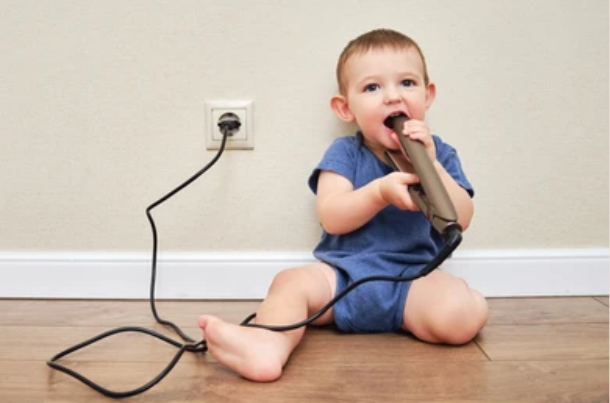
Baby puts phone charger in mouth, what should you do first? It can happen within seconds. One moment your baby is exploring beside you, and the next you notice a cable between their lips. This can be frightening, particularly when you do not know whether the charger was connected to power.
First, make the electrical source safe. If your baby is still in contact with an electrical source, do not touch them or the cable until the power is disconnected safely. Call emergency services immediately if your baby has trouble breathing, becomes unresponsive, has a seizure, or appears seriously unwell.
Once the immediate danger has passed, the next steps depend on the power source, the condition of the charger, and whether your baby has any symptoms.
A loose cable disconnected from every power source and a damaged cord connected to household electricity involve different risks. Both need to be removed from your baby’s reach, but the next medical step depends on the actual exposure.
What to Do When Your Baby Puts a Phone Charger in Their Mouth
You don’t need to know exactly what happened before seeking help. First, move your child away from the hazard safely. If a live wire may be involved, switch off the electricity before touching your child or the damaged item. Don’t put yourself at risk.
Once the area is safe, seek medical advice if your child may have received an electric shock, suffered a burn, or swallowed part of the item, even if they initially seem well. Explain what you saw and what may be missing; you don’t need to confirm the injury yourself. Call emergency services immediately for breathing difficulty, collapse, or poor responsiveness.
1. Disconnect the power safely
If the charger is plugged into an electrical outlet, disconnect the electricity at the circuit breaker or unplug it only if you can do so without contacting the baby, damaged parts, or wet equipment. Turning off the phone or the device being charged does not necessarily disconnect the electrical supply. Avoid touching wet equipment, exposed wiring, or your baby while they remain in contact with a possible live electrical source.
If you cannot safely stop the power, keep others away and call emergency services. Do not try to pull your baby away with your bare hands.
Once the electrical source is safely disconnected, gently remove the charger from your baby’s reach.
2. Check your baby’s breathing and responsiveness
Look at your baby first, rather than spending time inspecting the cable.
Call your local emergency number immediately if your baby:
- Is unresponsive or unusually difficult to wake.
- Has trouble breathing or is not breathing normally.
- Has a seizure, collapses, or appears seriously unwell.
- Has significant mouth swelling or heavy bleeding.
- Is choking and cannot breathe, cry, or cough effectively.
Follow the emergency dispatcher’s instructions, including instructions for infant CPR or choking first aid if needed.
3. Get urgent help for a possible electrical injury
If you suspect your baby received an electric shock or an electrical burn, contact emergency services for immediate guidance and arrange urgent medical assessment, even if they seem better afterward.
This is especially important if they bit through a powered cable, touched exposed wiring, or have a mark or burn around the mouth. Electrical injuries may be more significant than they first appear.
If your baby only mouthed an apparently intact charging connector, contact their pediatrician or an urgent medical advice service promptly if it was powered, you’re unsure what happened, or you notice any symptoms.
4. Look for damage without delaying care
Once your baby is safe, check whether the cable has bite marks, exposed wires, a broken connector, or missing pieces.
If a piece may have been swallowed, tell a healthcare professional what is missing. Do not induce vomiting or sweep your fingers blindly inside your baby’s mouth.
Keep the disconnected charger out of reach and take it, or a clear photograph, to the medical assessment if requested. Do not delay leaving or reconnect it to obtain more information.
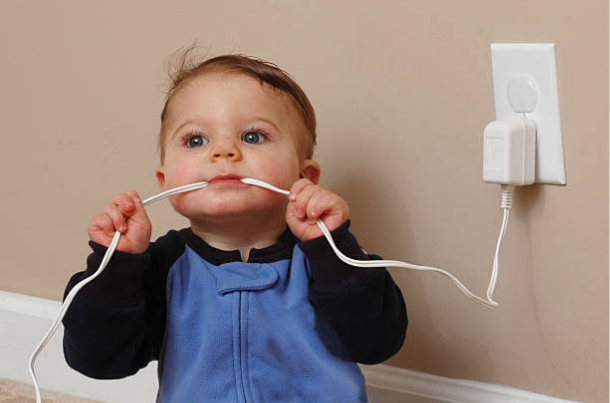
Does It Matter Whether the Charger Was Plugged In?
Yes. The electrical risk depends on what your baby touched and whether the equipment was connected to power.
However, “not plugged into the wall” does not always mean unpowered. A cable may still be connected to a power bank, computer, or another device.
A quick guide to the situation
| What happened | The next step |
|---|---|
| A loose cable was disconnected from every power source and remains intact | Remove it, check for an obvious injury, and seek advice if symptoms or uncertainty remain. |
| A powered charging tip was mouthed, with no obvious injury | Disconnect it safely and ask a clinician or urgent advice service about the exposure. |
| Powered wiring was exposed or bitten through, or shock or a burn is suspected | Seek immediate emergency guidance and urgent assessment. |
| A piece is missing | Get prompt medical advice; breathing or swallowing problems make the situation more urgent. |
| Your baby is unresponsive, not breathing normally, seizing, or bleeding heavily | Call emergency services immediately and follow first-aid instructions. |
A table cannot establish that a particular charger is safe. If you do not know which part was in your baby’s mouth, explain the setup and your uncertainty rather than choosing the most reassuring category.
A completely disconnected cable
If the cable was disconnected from every power source, it would not deliver an electric shock from an external supply.
There can still be other concerns. A damaged connector may scratch the mouth, loose pieces may become choking hazards, and a cable can present an entanglement risk.
If everything is intact and your baby has no symptoms, remove the cable and check their mouth gently. Seek advice if you notice an injury or cannot account for a missing piece.
A connector attached to a working charger
The output connector of a properly functioning phone charger normally supplies a lower voltage than household mains electricity. Brief contact with an intact connector is therefore different from biting into a mains electrical cord.
Still, that does not make it suitable for a baby’s mouth. Equipment faults, damage, exposed parts, and wet conditions can affect safety. A label or a connector’s appearance is not a home test of the exposure.
Avoid assuming either that serious injury definitely occurred or that everything must be harmless. Explain the exact exposure to a healthcare professional when there is uncertainty.
A damaged cord or household electrical connection
Biting through insulation on a powered mains cord, or contacting the plug’s electrical parts, is more concerning.
Treat a possible shock or electrical mouth burn as an urgent medical issue. Do not wait for a large visible injury before seeking help.
If you are unsure which part your baby reached, describe the whole setup rather than guessing.
What Signs Should Parents Watch For?
A baby may cry simply because something was taken away, but persistent discomfort or a change in behavior deserves attention.
Possible signs of injury include:
- A blister, pale patch, dark mark, or sore around the lips or mouth.
- Swelling or bleeding.
- Unusual drooling or apparent difficulty swallowing.
- Refusing feeds or crying during feeding.
- Persistent coughing, gagging, or noisy breathing.
- Unusual sleepiness, weakness, or reduced responsiveness.
These signs do not tell you the cause by themselves. They are reasons to get medical advice, particularly after contact with powered or damaged equipment.
A baby who is breathing normally and behaving normally may still need assessment if an electrical injury is suspected. Their immediate behavior cannot rule out every injury.
Why a Mouth Burn Needs Medical Attention
A small mark at the corner of the mouth can look less concerning than it is. Electrical mouth burns need professional assessment because the depth of injury may not be obvious.
Some electrical burns of the mouth can also bleed later as damaged tissue heals. If a clinician diagnoses a burn, ask for clear instructions about feeding, wound care, follow-up, and what to do if bleeding occurs. Do not assume the risk has passed because the first day seemed comfortable or the surface looks as though it is healing.
Seek emergency help for significant mouth bleeding, breathing difficulty, or rapidly increasing swelling. Call first rather than trying to inspect the wound repeatedly. Follow the dispatcher’s instructions about positioning and any bleeding control; do not push material deep into your baby’s mouth.
Do not put butter, toothpaste, oils, or household burn remedies inside your baby’s mouth. Avoid applying creams or medicines unless a healthcare professional recommends them.
What If Your Baby Chewed a Piece Off the Charger?
Missing material changes the next step. Your baby might have spat it out, swallowed it, or inhaled it, and you may not be able to tell which.
If breathing is affected or your baby cannot cough or cry effectively, call emergency services and follow infant choking first-aid instructions.
If breathing is normal but a piece is missing, get prompt medical advice. Mention whether it could be sharp, metallic, or large enough to cause a problem.
Do not try to push a suspected swallowed piece down with food or drink. A healthcare professional can advise whether your baby needs examination or further testing.
What to Tell the Healthcare Professional
When you’re frightened, it’s easy to forget details. A short description can help the clinician understand the exposure.
Try to explain:
- Your baby’s age and when the incident happened.
- Whether the cable was connected to a wall charger, computer, power bank, or nothing.
- Which part went into their mouth.
- Whether the cable or connector looks damaged.
- Any immediate reaction, such as a sudden cry or jerking movement.
- Any mouth marks, feeding changes, or breathing symptoms.
- Whether any pieces are missing.
It’s okay to say, “I’m not sure.” You don’t need a perfect account to ask for help.
An uncertain account is enough to start seeking help. You do not need to identify the voltage, diagnose a burn, or prove that a shock occurred before calling.
What Not to Do After the Incident
The urge to check everything quickly is understandable. Still, a few actions can make the situation more dangerous.
Do not reconnect the damaged charger to see whether it still works. Keep it disconnected and away from children.
Do not touch a potentially energized cable with wet hands, force your baby’s mouth open, or repeatedly rub a sore area.
Avoid relying on online photographs to decide whether a mark is an electrical burn. Different injuries can look similar, and an examination may be needed.
Most importantly, don’t delay emergency care while searching for reassurance online if your baby has serious symptoms.
If your baby has already been assessed
Follow the discharge instructions and attend any arranged follow-up. Ask which feeding changes, mouth changes, or bleeding signs mean you should return immediately. A new symptom deserves another call even after an initially reassuring assessment.
Do not apply an online burn-care routine to the inside of the mouth. Advice for a small external skin burn may not be suitable for an electrical injury involving the lips or mouth. Use medicines and wound products only as advised for your baby.
How to Keep Chargers Away From Curious Babies
Once the immediate situation is handled, a few practical changes can make the space safer. You don’t need to feel ashamed about noticing a hazard and correcting it.
Create one charging spot
Choose a location your baby cannot reach, with the device, adapter, and full length of cable kept out of reach.
A phone on a high table is still accessible if its cord hangs down beside a play mat. Check the entire route from the outlet to the device.
Keep charging equipment away from sleep spaces and water. Check that a mobile baby cannot reach it by pulling on a tablecloth, climbing, or opening an accessible drawer. Out of sight is not always out of reach.
Put cables away after use
Disconnect chargers when they are no longer needed and store them in a secure drawer or cupboard.
Keep cords out of cribs, play yards, and other places where a baby may sleep or become tangled. Avoid leaving spare cables in a diaper bag your baby can open.
A quick cable check can become part of tidying the room. Include spare adapters and power banks as well as cables. When visiting another home, check the space before putting your baby down to explore.
Replace damaged equipment
Stop using cables with split insulation, exposed wires, damaged connectors, or loose parts. Tape is not a reliable way to make a chewed cable safe.
Keep damaged equipment inaccessible until you can dispose of it through an appropriate electrical-waste route.
Check from your baby’s level
Get down near the floor and look beneath beds, behind sofas, and beside feeding chairs.
These are easy places to overlook when you’re standing. Ask other caregivers and older siblings to put chargers away too.
Offer an age-appropriate teething toy when your baby wants something to mouth, while keeping electrical items inaccessible.
Frequently Asked Questions
What should I do if my baby chewed phone-charger wiring?
Call emergency services immediately for breathing problems, unresponsiveness, seizures, serious burns, or significant bleeding.
Is brief contact with a charger tip dangerous?
A charging connector normally operates at a lower voltage than household mains electricity, but brief contact should not automatically be dismissed. Remove access and seek medical advice if it was powered, damaged, or the circumstances are unclear.
How can I prevent my baby from chewing a charger cable again?
A safe teething toy can provide an alternative, but supervision and inaccessible storage are still necessary.
Can my baby seem fine after an electrical injury?
If there was a suspected electric shock, contact with powered exposed wiring, or a possible electrical mouth burn, seek urgent medical assessment.
Should I throw away a charger after it has been bitten?
Do not reconnect it to test it. Replace questionable equipment and keep it away from your baby while arranging disposal.
Does a cable connected to a power bank count as powered?
Can a cable that is disconnected from everything cause a mains electric shock?
Can an electrical mouth burn bleed later?
Should I give milk or water after a possible injury?
Should I cover a chewed cable with tape and keep using it?
Final Thoughts
Finding a charger in your baby’s mouth can leave you shaken. Babies explore quickly, and noticing the danger is your cue to act, not a reason to blame yourself.
Make the power source safe, check your baby, and get prompt medical help when an electrical injury, burn, or swallowed piece is possible.
Afterward, move charging equipment into a secure place and ask everyone at home to follow the same routine. One practical change at a time can help make your baby’s growing world safer.
For now, keep charging equipment inaccessible and make sure every caregiver knows the immediate plan: disconnect the source safely, check the baby, and call for help when injury or serious symptoms are possible.
For more practical guidance on babyproofing and everyday care, explore Little One Haven. Share useful safety reminders with everyone caring for your baby, and keep emergency contact details easy to find.
Resources
Children’s Hospital of Philadelphia: Electrical Burns
MedlinePlus, U.S. National Library of Medicine: Electrical Injury
PubMed: Infant Electrocution Due to Smartphone Charge Cable, A Hidden Public Health Risk
Disclaimer
This article is for general educational and baby-safety information only and does not replace individualized medical or emergency advice. If your baby is still in contact with a possible live electrical source, do not touch them until the electricity has been disconnected safely. Seek urgent medical assessment for a suspected electric shock, electrical mouth burn, powered exposed wiring, or a possible swallowed charger piece. Call emergency services immediately for breathing difficulty, unresponsiveness, seizures, significant mouth swelling or bleeding, serious illness, or choking when your baby cannot breathe, cry, or cough effectively. Do not induce vomiting, push food or drink down to move a suspected object, reconnect damaged equipment to test it, or apply household burn remedies inside your baby’s mouth.
This article is for general educational and baby-safety information only and does not replace individualized medical or emergency advice. If your baby is still in contact with a possible live electrical source, do not touch them until the electricity has been disconnected safely. Seek urgent medical assessment for a suspected electric shock, electrical mouth burn, powered exposed wiring, or a possible swallowed charger piece. Call emergency services immediately for breathing difficulty, unresponsiveness, seizures, significant mouth swelling or bleeding, serious illness, or choking when your baby cannot breathe, cry, or cough effectively. Do not induce vomiting, push food or drink down to move a suspected object, reconnect damaged equipment to test it, or apply household burn remedies inside your baby’s mouth.